
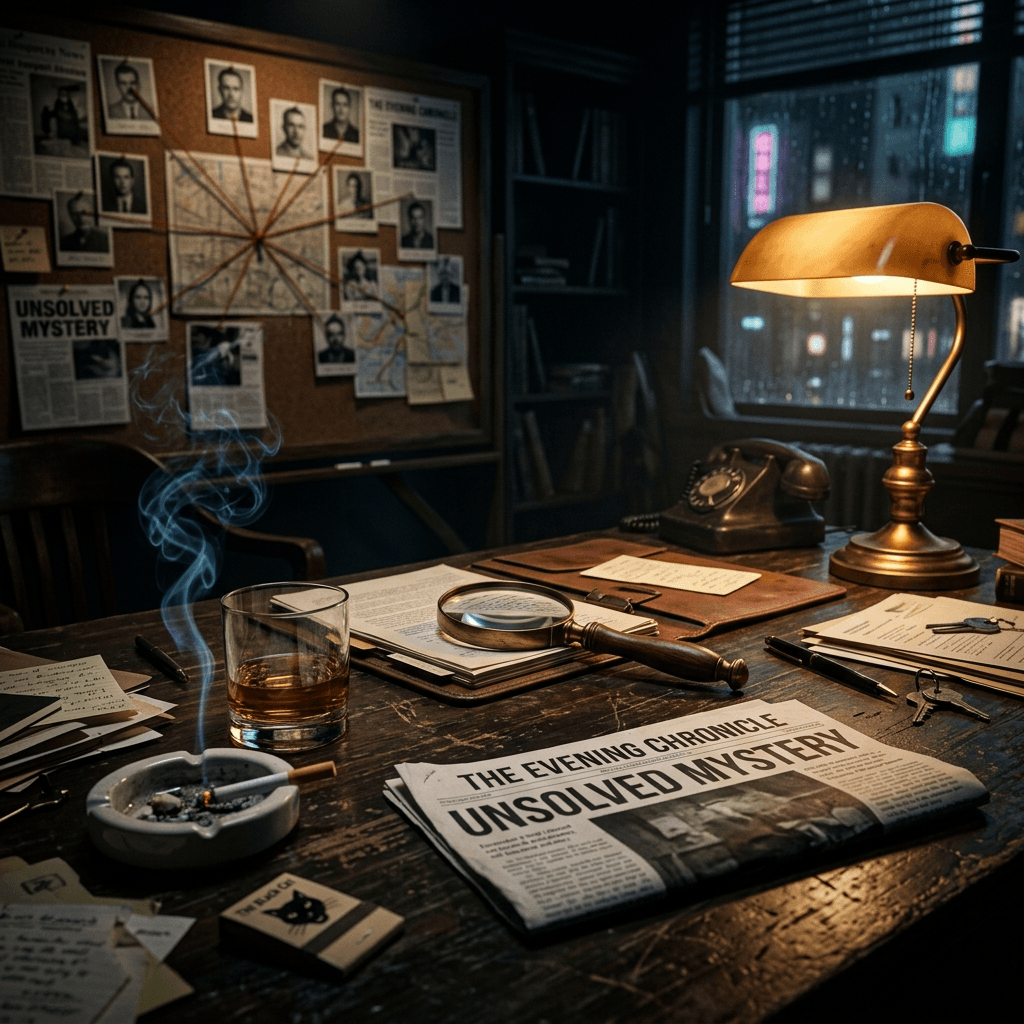
Games like Clue — but online, replayable, and the suspects talk back.
Cluedo is a great twenty-minute game, but you have already learned that Colonel Mustard does it in the conservatory with the lead pipe more often than is mathematically defensible. If you want the whodunit shape with actual investigation in it — suspects you interrogate, evidence you piece together, a story that has a real ending — this is what that looks like in 2026. The demo below is free.
Why Clue is great — and where it stops
Clue (Cluedo, if you grew up outside the US) is a brilliant piece of game design. Six suspects, six weapons, nine rooms — 324 combinations that you narrow down to one through a mechanical process of elimination. It teaches the core feeling of investigation in twenty minutes, which is why it has been in print since 1949.
What it does not have is story. Colonel Mustard never explains why he did it. Mrs Peacock never lies to you about where she was at 9:47 pm. The conservatory does not have an inconvenient receipt from the gas station two miles away. You are not really investigating — you are solving a logic puzzle whose pieces happen to be named after people.
The second time you play Clue with the same group, you know the system. The third time, you know the optimal opening question. By the tenth time, the cards on the table are different but the game is the same. The fun is in the social moment, not the case.
If you have hit that plateau and still want the whodunit shape — a victim, a set of suspects, a culprit you have to identify — the version that scales is the one where the suspects can actually answer you.
Side-by-side: Clue vs. Molverine
Same whodunit shape, completely different texture.
| Clue (board game) | Molverine | |
|---|---|---|
| Format | Board + cards on a table | Browser tab, any device |
| Players | 3–6 required | 1 (solo) or 2–6 (group around one screen) |
| Suspect behaviour | None — they are cards | Each is an AI character with a backstory and a secret |
| Investigation mechanic | Roll a die, suggest a triple | Ask questions in plain English, react to evidence |
| Replay value | Same system every game; only the card draw changes | Same case can play differently — AI answers different questions differently |
| Story | None — it is a logic puzzle | Real case with motive, timeline, lab work |
| Length | 20–45 minutes | 20 min (demo) to 4 hours (full case) |
| Cost | $15–25 one-time | Free demo, $13.90 per full case |
From card-tracking to actual investigation
Clue's deduction grid — the little checklist where you tick off which cards opponents must not have — is the core mechanic that makes the game feel like detective work. It is also the part that turns out to be solvable by pure bookkeeping.
Molverine keeps that feeling but trades the grid for an evidence board. You pin suspects, motives, weapons, alibis, and lab results onto a freeform canvas, draw connections between them, write theories in the margins. It is messier than a grid but closer to how detectives actually think.
More importantly, the suspects fight back. You cannot solve a Molverine case by elimination alone — you have to get someone to slip up, contradict themselves, or react badly to a piece of evidence. That is what carries replay value: the suspects answer differently every conversation.
Suspects with memory
They remember your earlier questions. Set up a contradiction five turns ago, then close it now.
Free-text questioning
No multiple choice. No menu. Type the question a real detective would ask.
Lab work, not dice
Submit physical samples — bloodwork, prints, ballistics. Reports come back. They settle arguments.
Persistent evidence board
Sleep on it. The board waits for you. The grid in Clue resets every game.
Other games like Clue worth knowing about
We are listed first because this is our page — but here is the honest landscape.
Molverine
This one. Browser-based, AI-driven interrogations, real cases, free demo.
Best for: Replayability, single-player, story.
Sherlock Holmes: Consulting Detective
Cooperative board game where you flip through a casebook of leads. Closer to a detective novel than to Clue.
Best for: Pure deduction, group of 2-8, no electronics.
Mysterium
Cooperative ghost-themed deduction with abstract art cards. One player is the ghost; others interpret visions.
Best for: Atmosphere, mixed-skill groups, lighter than Clue.
Chronicles of Crime
App-driven board game — interrogate witnesses, search scenes in VR. Modern, replayable, scenario-based.
Best for: Tech-positive groups, more interactive than Clue.
Return of the Obra Dinn
Solo video game — identify 60 sailors who died on a derelict ship using only stop-motion vignettes.
Best for: Pure deduction, no AI, no group needed.
Demo is free. A case is $13.90, owned forever.
Same model as buying a board game — pay once for a case, play it as many times as you want, with whoever you want. No subscription, no per-seat fee, no in-game purchases. The demo on this page never asks for an account or a card.
Questions Clue players usually ask
The full FAQ covers refunds, age rating, devices, and accounts.
Is this actually like Clue?+
Do I need a group, like with Clue?+
How long is one game?+
Is it free? Clue I bought once and own forever.+
What if I prefer the deduction-grid feel of Clue?+
Same whodunit shape. Different texture.
Twenty minutes, no setup, no board. One case. The suspects are waiting for the question you have not asked yet.
Start the free demo